A spiritual home for Catholics in Hyde Park since 1869
The History of St. THomas the Apostle is the History of Hyde Park

The Early Years
Before the Civil War, before the Great Fire, even before Hyde Park became incorporated as a town, Catholics were worshipping here. The first community was largely of Irish heritage, both businessmen and domestic workers.
In 1868,when Hyde Park was a country town, Bishop Duggan came here for the summer. He rented a house on the northwest corner of Blackstone Avenue and 53rd Street, and there, on a July morning, Mass was first celebrated in this vicinity.
The first permanent pastor was Rev. Patrick T. Butler, appointed in the Fall of 1868, when the bishop went back to his permanent residence. He was taking care of the Parish until Summer 1869, when he was transferred to the Immaculate Conception Parish in Chicago.
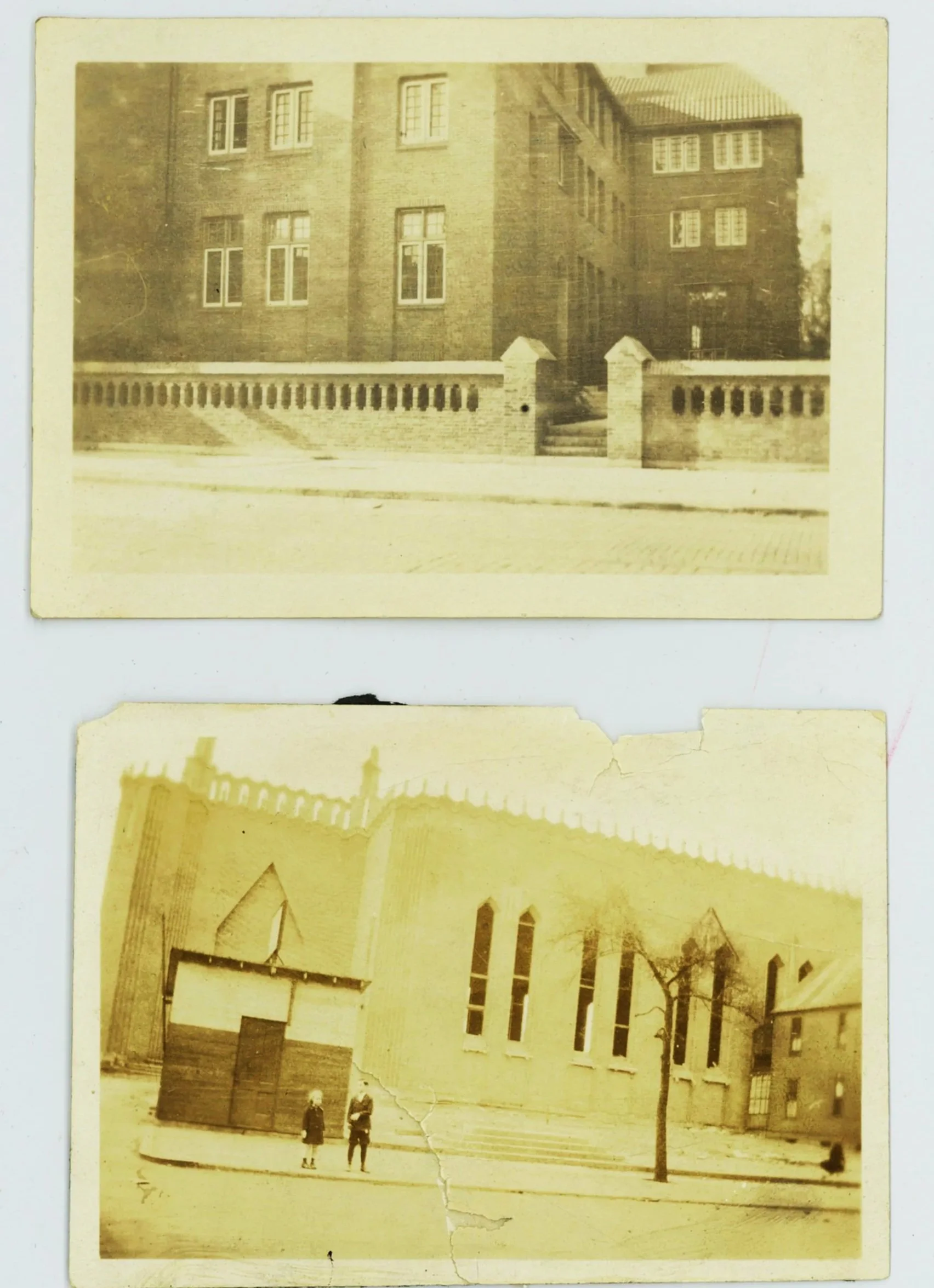
He was replaced at St. Thomas the Apostle by Rev. Joseph D. Bowles, who first offered Mass in the old Kenwood School at 51st Street and Lake Park Avenue and then he rented a house on Kenwood Avenue just north of 55th Street. Toward the close of 1869, Father Bowles built the first Catholic church in Hyde Park — a little brown frame structure, on the corner of 55th Street and Kimbark Avenue, facing south on 55th Street.
In that church Mass was offered for nearly 20 years through the successive pastorates of Rev. Thomas F. Leyden [late 1869-1870], Rev. Thomas Kennedy [1870-1873], Rev. P. M. Flannigan [1873-1875], Rev. Louis Lightner [1875-1877], Rev. Dennis A. Tighe [1877-1880], and Rev. W. A. Horan [1880-1887]. In addition to caring for their flock in this locality, they were shepherds of the souls in South Chicago and Ainsworth, missions of St. Thomas the Apostle.
Within twenty years and before Hyde Park became part of Chicago, before the University of Chicago was founded, and before the World Columbian Exposition; Saint Thomas the Apostle Parish had outgrown its first church and was busy building another church on this site. The second church was built and dedicated in 1890, at the beginning of the long pastorate of Rev. Joseph J. O’Carroll. This time – a large brick building in Victorian Gothic Style
The Time of Growth
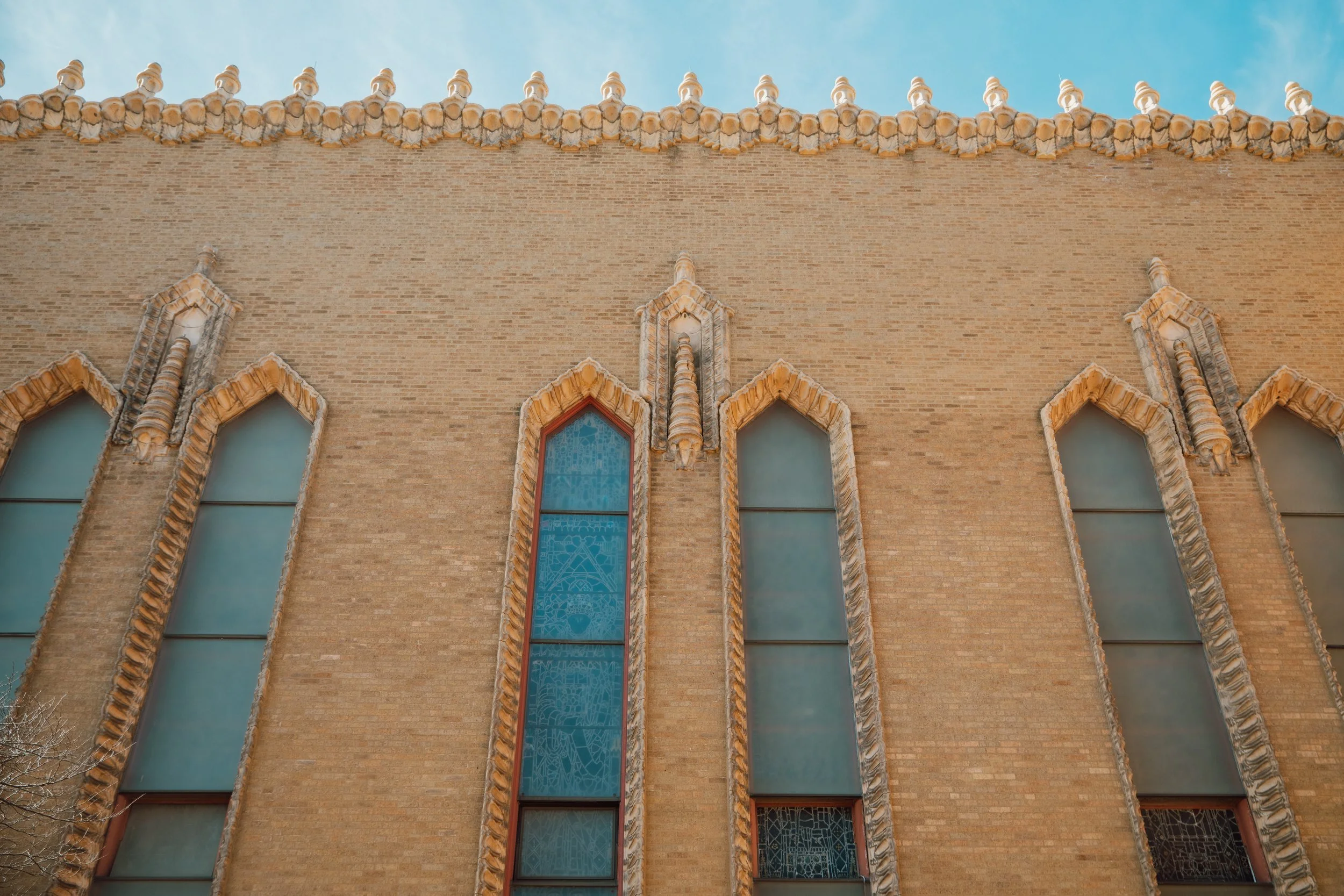
After Fr. O’Carroll [1887-1916], in 1916, Monsignor Thomas Shannon (1874-1959) was appointed pastor and came to be known within the parish as the “great builder.” He was responsible for commissioning all the buildings you see here today. In 1921 he retained Francis Barry Byrne to build a third church, and this was completed in 1924. Architect Byrne had already designed the convent in 1919, and for the church he collaborated with Alfonso Iannelli. Due to the radical nature of both the design and materials used, the realization of Architect Byrne’s conception caused our church of Saint Thomas the Apostle to became known as the first modern American Catholic church.
The parish has continued to grow and has been served by many outstanding priests of the Archdiocese of Chicago. Notable among them are two long serving pastors of recent memory, Father Farry and Father Fitzgerald who was honored by the city with the memorial renaming of Kimbark Avenue at 55th Street in his honor. At the end of the 20th century the parish of Saint Gelasius in Woodlawn was merged together with Saint Thomas the Apostle, and the boundaries of the parish were greatly extended southward to include Woodlawn as well as Hyde Park.
During the 1960s through the 1980s, St. Thomas the Apostle remained rooted in the community in the midst of Community change
From the 1960s through the 1980s, St. Thomas the Apostle Catholic Church in Hyde Park stood at the crossroads of profound demographic, cultural, and social change as the neighborhood grappled with questions of race, housing, and integration. This was a time when Hyde Park became a focal point for urban renewal and intentional integration, as community leaders, residents, and institutions sought to resist the patterns of white flight and racial segregation that had shaped much of Chicago. For St. Thomas, a parish long rooted in Hyde Park’s Catholic presence, the challenge was how to live out the Gospel mandate of hospitality and justice in the midst of these shifts. Parishioners witnessed blocks of their neighborhood transition as African American families moved in, while some white residents moved away, fearful of declining property values or racial change. The Church, however, increasingly positioned itself as a bridge-builder, committed to holding together a diverse parish community.
During these decades, parish life reflected broader integration efforts: school enrollment began to mirror the racial diversity of the neighborhood; liturgies and parish events became gathering spaces for Black, white, and immigrant Catholics alike; and clergy preached regularly about unity in Christ that transcended social barriers. St. Thomas collaborated with neighborhood organizations that promoted fair housing and resisted discriminatory practices, recognizing that Catholic witness could not be confined to the sanctuary but had to extend into the fabric of civic life. While there were tensions—some parishioners struggled with change, and not all efforts succeeded without conflict—the parish’s identity as a Hyde Park anchor deepened. By the 1980s, St. Thomas had developed a reputation not just as a neighborhood parish but as a sign of Hyde Park’s commitment to stable integration, rooted in the conviction that the Body of Christ is strongest when every race and culture finds a home at the same altar. The story of these decades is one of courage, resilience, and faith: a parish that chose to remain, adapt, and bear witness to the power of Catholic community in the face of urban change.
Today, we welcome all of God’s People in Extraordinary Variety!
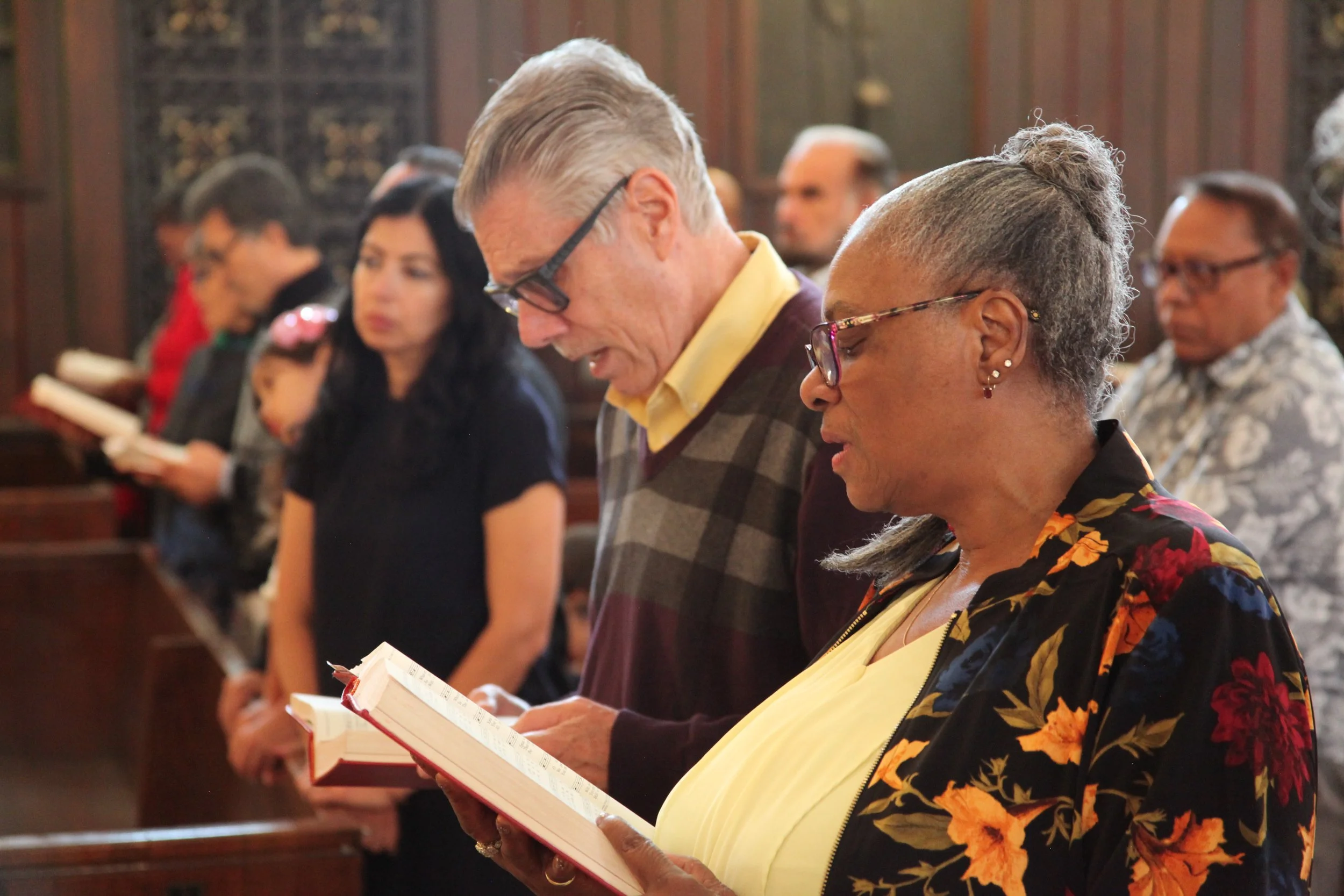
Today, St. Thomas the Apostle is a vibrant Catholic community in Hyde Park where faith, worship, and service come together. We are a diverse and welcoming parish where people gather to encounter Christ through the Eucharist, prayer, and community. Our liturgies are celebrated with reverence and joy, and our ministries provide opportunities to grow in faith, build friendships, and serve those in need. Whether you are a longtime parishioner, new to the neighborhood, or seeking a place to belong, we invite you to find a spiritual home here at St. Thomas the Apostle.
Today, St. Thomas the Apostle School carries forward this same mission by providing children from preschool through 8th grade with an excellent Catholic education. Rooted in faith and strengthened by academic rigor, the school helps students discover their gifts and grow into responsible, compassionate leaders. With dedicated teachers, supportive families, and a nurturing environment, our school prepares young people not only for success in high school and beyond, but for a lifetime of living their faith with joy. Together, our parish and school extend a warm invitation: come and see how God is at work in our community, and join us in building a future filled with hope and faith.
List of Pastors who have served St. Thomas the Apostle Catholic Church and School
1st Pastor - Rev. Patrick T. Butler (1868-1869)
2nd Pastor - Rev. Joseph D. Bowles (Jul-Nov 1869)
3rd Pastor - Rev. Thomas F. Leydon (1869 Nov - 1870)
4th Pastor - Rev. Thomas Kennedy (1870-1873)
5th Pastor - Rev P. M. Flannigan (1873-1877)
6th Pastor - Rev. Louis (Aloysius) Lightner (1875-1877)
The first not-Irish Pastor of St. Thomas, born in Lemberg, The Austro-Hungarian Empire (now - Lviv, Ukraine)
7th Pastor - Rev. Dennis A. Tighe (1877-1882)
8th Pastor - Rev William A Horan (1880-1887)
Fr. Horan was the Pastor who built the School and invited Sinsinawa Dominican Sisters to St. Thomas the Apostle.
9th Pastor - Rev. John J. Carroll (1887-1916)
A scholar and a writer, the longest-serving Pastor of St. Thomas the Apostle (29 years)
10th Pastor - Msgr. Thomas V. Shannon (1916-1941),
aka "the Monsignor," who spent 25 years at St. Thomas the Apostle. Our church building, as well as our School and Convent, were constructed under him.
11th Pastor - Rev. Charles A. Murphy (1941-1950)
"Fr Murphy's pastorate spanned the war years and the beginning of racial change in the Hyde Park neighborhood ... a time of popularity and hospitality at St. Thomas. "
12th Pastor - Rev Edmund P. Godfrey (1950-1955)
“His gentle administration was faced with difficult days.” It was the time when the Hyde Park-Kenwood Community Conference (1949) and the South East Chicago Commission (SECC) were created in response to many new challenges the neighborhood had to face. St. Thomas soon became a part of that process.
For the parishioners of St. Thomas, the Apostle, Fr. Godfrey's pastorate was marked by the newly organized Living Stations, the Sacred Concerts—Handel's Messiah, conducted by his Associate Fr. Robert Tyrrell, and the restored Parish Drama Group, led by another Associate Fr. Joseph C. Taylor.
13th Pastor - Rev. Edward S. Krakowski (1955-1962)
Fr. Krakowski's term as pastor was warm and friendly. The bowling league got started again and new choir accommodation was built. He was known for arranging beautiful decorations for the altar at Christmas and Easter.
During his pastorate, St. Thomas became one of the first places with a Dialog Mass facing people (during the Forty Hours).
Jacques Maritain, a prominent French Catholic philosopher, was a frequent worshiper at St. Thomas those days.
14th Pastor - Rev William J Dorney (1962-1967)
In 1963 Fr Dorney started a unique program “Distinguished Preachers Sunday”, inviting notable guest preachers (usually well known in the Church) to preach on Sundays or special occasions. Among them, there were: Rev. Sylvester McNutt O.P., a professor at C.U.A.; Fr. John E. Blewett, S.J., Dean of Sophia University, (Tokyo, Japan); Fr. Willam Graney, assistant Editor of the New World, Fr. Andrew A. Greely (who later became a new assistant at the STA), Bishop Fulton J. Sheen, and others.
Besides his pastoral duties at St. Thomas he was
• a vice president of the Hyde Park Interfaith Council,
• a member of the board of directors of the Southeast Chicago Commission,
• a member of Albert Cardinal Meyer's Urban Affairs Committee,
• a director of the Hyde Park-Kenwood Community Conference, and
• was active in the right-to-life movement
15th Pastor - Rev Thomas J Fitzgerald (1968-1988),
A much-beloved priest and community leader in the Hyde Park community. Fr. Fitz served at St. Thomas from 1968 until 1988, when he became Pastor Emeritus and was succeeded by Fr. Farry. In the 20 years period of his pastorate, he served as a very effective president of the Hyde Park Interfaith Council of Churches and Synagogues and was a leading member of the Hyde Park Conservation Community Council, becoming a faithful Hyde Parker.
16th Pastor - Rev. John A. Farry (1988-2000)
“The task of the church now is “to remember the past, to believe in the future and to celebrate what's happening now”
17th Pastor - Rev. Michel G. Foley (2000-2001)
18th Pastor - Rev Michael Mulhall O.Carm (2001-2010) - St. Thomas was given over to the Carmelites for administration after St. Gelasius was closed by the Archdiocese of Chicago. St. Gelasius was the Carmelite parish located in Woodlawn on 64th and S. Woodlawn who also administered Mount Carmel High School. It is now the national headquarters for the Institute of Christ the King Sovereign Priest.
19th Pastor - Fr. Elias O’Brien, O. Carm (2010 - 2019)
20th Pastor - Fr. Michael Trail (2021 - current)
Fr. Trail was the first diocesan pastor after parish returned to the Archdiocese of Chicago, having been previously cared for by the Carmelites. In his time at St. Thomas, he worked to improve the quality of the school as well as to bring the parish out of the COVID-19 global pandemic to a vibrant parish in the community. He revived programs such as the The Distinguished Preachers and partnered the parish more deeply with the Catholic Theological Union and the University of Chicago.